
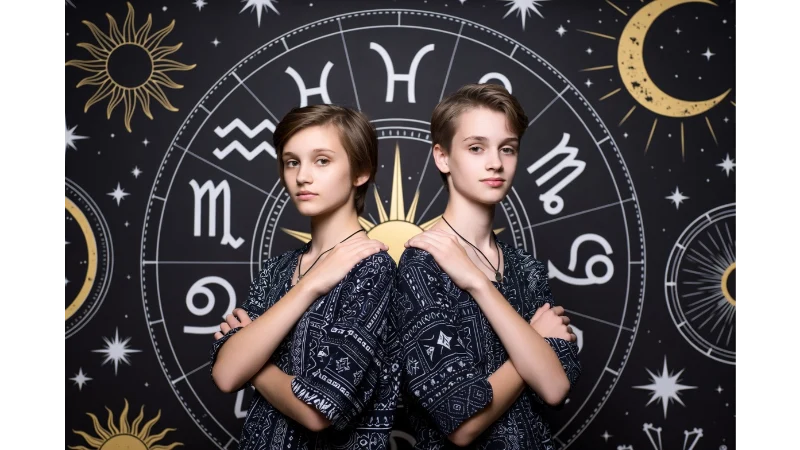
In the fascinating world of astrology, one question often arises that challenges even seasoned practitioners: If twins are born just minutes apart, sharing nearly identical birth charts, why do they often lead such different lives and exhibit distinct personalities? This so-called “twin paradox” has puzzled skeptics and astrologers alike for centuries. As a dedicated astrology expert with years of experience analyzing natal charts, including those of twins, I’ve seen firsthand how subtle cosmic nuances can create profound divergences. In this comprehensive guide, we’ll explore the astrological mechanisms behind these differences, drawing on historical insights, technical explanations, and real-world examples to provide the definitive resource for anyone curious about astrology twins. Whether you’re a twin yourself, a parent of multiples, or simply intrigued by zodiac mysteries, this article will equip you with deep, actionable understanding—proving that astrology isn’t about rigid fate but a dynamic blueprint for individuality.
The Twin Paradox in Astrology: What It Is and Why It Matters
The twin paradox refers to the observation that identical twins—sharing the same DNA, upbringing, and birth moment—frequently develop contrasting traits, careers, and life paths. Skeptics use this to question astrology’s validity, arguing that if planetary positions at birth dictate destiny, twins should be carbon copies. However, astrology views the natal chart as a multifaceted map of potentials, not a deterministic script.
Historically, this debate traces back to ancient times. Roman philosopher Cicero critiqued astrology by noting that people born at the same instant in different places led varied lives. Early astrologers like Ptolemy countered that external factors, such as geography and family, interact with celestial influences. Today, modern astrology builds on this, emphasizing that even minor time gaps can shift key chart elements, amplifying unique expressions.
Key to understanding: Astrology distinguishes between identical twins (monozygotic, same genetics) and fraternal twins (dizygotic, like regular siblings). While fraternal twins may have more obvious chart differences due to conception timing, identical twins highlight astrology’s precision. Related concepts include time twins (non-related people born simultaneously) and the zodiac sign Gemini, symbolized by twins, representing duality and adaptability.
The Crucial Role of Exact Birth Time in Twin Charts
Birth time is astrology’s cornerstone. Even seconds matter because the Earth rotates 15 degrees per hour, altering the sky’s alignment. For twins, a delivery delay of just 4-5 minutes can change the ascendant (rising sign), which governs first impressions, physical appearance, and life approach.
Consider this: The natal chart—a snapshot of planets, signs, and houses at birth—includes fast-moving points like the ascendant, which shifts signs every two hours. If Twin A emerges at 12:00 PM with a Leo rising (confident, dramatic), Twin B at 12:15 PM might have Virgo rising (analytical, reserved). This cascades through the houses in astrology, repositioning planets and altering life themes—e.g., career (10th house) or relationships (7th house).
Practical tip: Always record birth times precisely, ideally from hospital records. In consultations, I’ve adjusted charts for twins using rectification techniques, revealing hidden divergences. For instance, one set of twins I worked with had the Moon on the cusp between signs; a 10-minute gap pushed it from emotional Cancer to logical Leo, explaining one twin’s nurturing career in teaching versus the other’s analytical role in tech.
How the Ascendant and Houses Differentiate Twin Personalities
The ascendant sign acts as the chart’s “front door,” filtering how planetary energies express. In twins, even if core placements like sun sign, moon sign, and zodiac signs match, a differing ascendant reshuffles the 12 houses, which represent life areas.
- Houses and Planetary Positions: Planets in houses gain context. A Mars in the 1st house (self) might make one twin assertive and athletic, while in the 2nd (values) for the other, it fuels financial ambition.
- Cusps and Transitions: Twins born near sign cusps amplify differences. If the ascendant hovers on a cusp, minutes decide whether it’s fiery Aries or earthy Taurus.
Real-world example: Famous twins Mary-Kate and Ashley Olsen (born June 13, 1986) share Gemini suns but reportedly have slight ascendant variations, contributing to one pursuing fashion design and the other acting. This aligns with Gemini’s dual nature, but house shifts highlight individual paths.
Planetary Degrees, Aspects, and Subdivisions: The Hidden Layers
Beyond basics, astrology delves into planetary degrees and aspects (angles between planets). The Moon moves 13 degrees daily, so a 15-minute gap equals about 3 degrees—enough to alter aspects or enter new subdivisions.
- Degrees and Aspects: A planet at 29 degrees might be “anaretic” (intense, karmic), while 0 degrees is fresh energy. Aspects like trines (harmonious) or squares (challenging) can shift from applying (building) to separating (resolving) in minutes.
- Subdivisions: Advanced tools like decans (10-degree segments ruled by planets), bounds/terms (Egyptian subdivisions emphasizing traits), and twelfth-parts (micro-zodiacs) create nuance. For example, if Twin A’s ascendant falls in Venus bounds (artistic, harmonious), they might thrive in creative fields, while Twin B’s in Mars bounds (competitive) pursues sports.
In my practice, a pair of identical twins born 8 minutes apart had the ascendant in different bounds: One Venus-ruled (became a musician), the other Mars-ruled (military career). This underscores astrology’s depth—subdivisions explain why twins “divide” the chart, each embodying select energies.
Timing Techniques: Transits, Progressions, and Life Cycles
Astrology isn’t static; timing methods like transits (current planetary movements) and progressions (symbolic chart advancement) activate potentials differently for twins due to degree sensitivities.
- Transits and Progressions: A transit Saturn might conjunct one twin’s progressed Moon earlier, triggering maturity themes like career shifts.
- Zodiacal Releasing: This Hellenistic technique divides life into periods based on lot of fortune (a calculated point). A few degrees can shift phases by years, explaining why one twin marries young while the other focuses on education.
Free Will, Environment, and Karma: Beyond the Stars
Astrology integrates free will—charts show potentials, not prisons. Twins, striving for individuality, subconsciously “choose” expressions: One might lean into a bold Sun-Mars aspect as a leader, the other as an artist.
- Environment and Nurture: Family dynamics, culture, and experiences shape outcomes. Synastry (chart comparisons) reveals how parental charts interact differently with each twin.
- Karma and Reincarnation: In evolutionary astrology, souls carry past-life imprints. Twins might incarnate together for shared lessons but diverge to balance individual karma.
Scientific tie-in: Twin studies, like the Minnesota Twin Family Study, show genetics account for 50% of traits, with environment filling the rest—mirroring astrology’s nature-nurture blend.
Famous Twins in Astrology: Real-Life Case Studies
Examining celebrities illuminates the twin paradox:
- The AstroTwins (Ophira and Tali Edut): Born December 2, 1972, these Sagittarius sisters share charts but express differently—one focuses on writing, the other media—likely due to ascendant subtleties.
- The Bee Gees Twins (Robin and Maurice Gibb): Born December 22, 1949, their Capricorn suns aligned in music, but personal lives diverged, reflecting Moon degree shifts.
- Ann Landers and Abigail Van Buren: Cancer suns (born July 4, 1918), they became rival advice columnists, showcasing competitive aspects activated uniquely.
These cases demonstrate how twins co-create distinct narratives from shared cosmic foundations.
Vedic Astrology Perspectives on Twins
In Vedic astrology (Jyotish), twins are analyzed via dashas (planetary periods) and divisional charts like Navamsa (D-9 for deeper soul insights). Birth order matters: The elder twin aligns with the 11th house (gains), younger with the 3rd (courage).
Predictions for twins include specific yogas (combinations): If Mercury aspects Gemini with Sun/Jupiter, male twins are indicated. Differences arise from prana (life force) variations at birth.
Integrating Scientific Twin Studies with Astrology
Modern research complements astrology. Identical twins reared apart show similarities in habits (nature) but differences in choices (nurture). Astrology adds a cosmic layer: Charts predict predispositions, science explains adaptations.
For parents: Use twins’ charts for personalized guidance—e.g., one with strong Venus might excel in arts, the other with Mercury in communication.
Conclusion: Embracing the Cosmic Duality of Twins
Astrology twins reveal the beauty of individuality within unity. By understanding birth time precision, chart layers, and holistic factors, we see how the stars guide without dictating. If you’re a twin or know one, calculate your charts (tools like Astro.com) and explore these subtleties—it’s a journey of self-discovery. Astrology empowers us to navigate potentials with wisdom, turning paradoxes into profound insights
Frequently Asked Questions (FAQs)
What is the twin paradox in astrology?
The twin paradox questions why twins with similar birth charts have different lives, explained by time differences shifting ascendants and subdivisions.
Can twins have completely identical natal charts?
Rarely— even seconds apart change degrees and aspects, leading to unique expressions despite shared core placements.
How does birth time affect twins’ astrology?
Minutes can alter the rising sign, houses, and planetary strengths, creating distinct personality and life themes.
Why do identical twins have different personalities in astrology?
Free will, environment, karma, and subconscious division of chart energies allow individual manifestations.
What role does Gemini play in twin astrology?
Gemini, ruled by Mercury and symbolized by twins, represents duality, communication, and adaptability often seen in twin dynamics.
How does Vedic astrology handle twins?
It uses divisional charts and birth order (elder/younger houses) to differentiate, plus karmic yogas for predictions.
Are there famous examples of astrology twins?
Yes, like the AstroTwins or Olsen sisters, where subtle chart variations lead to unique paths despite similarities