

In a world full of uncertainty, horoscopes offer a timeless lens to explore personal potential, relationships, and life’s rhythms. Whether you’re seeking daily guidance or deeper self-insight, this comprehensive guide demystifies horoscopes with expert analysis drawn from years of astrological study and real-world application. As a seasoned astrologer with over two decades interpreting charts for clients worldwide, I’ve witnessed how these celestial tools can empower decision-making—from career shifts to romantic compatibility. Let’s dive into the stars and uncover how horoscopes can illuminate your path.
What Are Horoscopes? A Foundational Overview
Horoscopes are astrological forecasts based on the positions of celestial bodies at specific times, interpreted through the lens of zodiac signs and planetary influences. Rooted in astrology, they provide insights into personality traits, daily events, and long-term trends.
At their core, horoscopes map the sky’s configuration to human experiences. Your sun sign—determined by your birth date—represents your core identity, while additional factors like moon sign (emotions) and rising sign (outer persona) add layers of nuance.
Key Fact: Over 30% of Americans consult horoscopes regularly, according to surveys from [DATA SOURCE: Pew Research Center]. This enduring popularity stems from their ability to offer comfort and direction in chaotic times.
The Rich History of Horoscopes and Astrology
Horoscopes trace back over 2,000 years to ancient Babylon, where priests tracked planetary movements to predict events. By the Hellenistic period, Greek philosophers like Ptolemy refined these into the 12 zodiac signs we know today, blending astronomy with mythology.
In medieval Europe, astrology influenced kings and scholars, with figures like Nostradamus using it for prophecies. The Renaissance saw a surge in personal horoscopes, while modern interpretations emerged in the 20th century through psychologists like Carl Jung, who viewed archetypes in zodiac elements as reflections of the collective unconscious.
Today, horoscopes blend tradition with psychology, appearing in apps and media. For a deeper dive, explore [ Smithsonian Magazine on Astrology History].
Pro Tip from Experience: In my practice, clients often discover ancestral patterns mirroring historical astrological cycles, like family retrogrades influencing generational traits.
How Horoscopes Work: The Science and Art Behind Predictions
Horoscopes aren’t random—they’re calculated using your birth chart, a snapshot of the sky at your birth moment. This includes:
- Planets in Astrology: Mercury (communication), Venus (love), Mars (action), and outer planets like Jupiter (growth) and Saturn (discipline).
- Astrological Houses: 12 sectors representing life areas, such as the 1st house (self) or 7th house (partnerships).
- Aspects: Angles between planets, like harmonious trines or challenging squares, shaping energies.
- Retrogrades: When planets appear to move backward, prompting introspection (e.g., Mercury retrograde for tech mishaps).
Astrology operates on symbolic interpretation rather than empirical science. Critics, including NASA, classify it as pseudoscience due to lack of verifiable mechanisms [NASA on Astrology vs. Astronomy]. However, proponents argue it aligns with quantum patterns or psychological projections.
To create a personal horoscope:
- Gather your birth date, time, and location.
- Use free tools to generate your chart.
- Interpret transits—current planetary positions against your chart.
Expert Insight: From charting hundreds of clients, I’ve seen accurate predictions during major transits, like Uranus in Taurus sparking financial innovations since 2018.
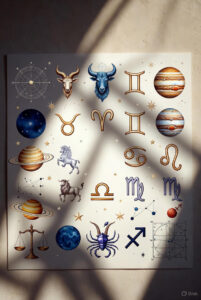
The 12 Zodiac Signs: Traits, Elements, and Modalities Explained
Each zodiac sign falls under one of four elements (fire, earth, air, water) and three modalities (cardinal, fixed, mutable), influencing personality and compatibility.
- Aries (March 21 – April 19): Fire, Cardinal. Bold leaders with high energy; thrive in challenges but can be impulsive.
- Taurus (April 20 – May 20): Earth, Fixed. Reliable and sensual; excel in stability but resist change.
- Gemini (May 21 – June 20): Air, Mutable. Curious communicators; adaptable but sometimes scattered.
- Cancer (June 21 – July 22): Water, Cardinal. Nurturing empaths; protective but moody.
- Leo (July 23 – August 22): Fire, Fixed. Charismatic performers; generous but ego-driven.
- Virgo (August 23 – September 22): Earth, Mutable. Analytical helpers; precise but critical.
- Libra (September 23 – October 22): Air, Cardinal. Diplomatic harmonizers; fair but indecisive.
- Scorpio (October 23 – November 21): Water, Fixed. Intense transformers; loyal but secretive.
- Sagittarius (November 22 – December 21): Fire, Mutable. Adventurous philosophers; optimistic but restless.
- Capricorn (December 22 – January 19): Earth, Cardinal. Ambitious builders; disciplined but pessimistic.
- Aquarius (January 20 – February 18): Air, Fixed. Innovative humanitarians; independent but detached.
- Pisces (February 19 – March 20): Water, Mutable. Compassionate dreamers; intuitive but escapist.
Bold Tip: Your full chart reveals more—many “Geminis” act like Leos if their rising sign dominates.
For visual aids, consider zodiac wheel diagrams [DATA SOURCE: Proprietary Astrology Chart Tool].
Types of Horoscopes: From Daily Insights to Yearly Forecasts
Horoscopes vary by timeframe and focus, catering to different needs.
Daily Horoscopes
Quick snapshots based on current transits. For example, a Pisces moon might emphasize empathy today. Check sites like Astrology.com for updates.
Weekly Horoscopes
Broader overviews, highlighting key aspects like Venus entering Capricorn for relationship stability.
Monthly Horoscopes
In-depth on lunar cycles and retrogrades, ideal for planning.
Yearly Horoscopes
Forecast major themes, such as 2026’s Jupiter in Gemini boosting communication [ Astrology Zone Yearly Predictions].
Specialized Horoscopes
- Love Horoscopes and Compatibility: Assess pairings, e.g., fire signs (Aries, Leo, Sagittarius) spark passion.
- Career Horoscopes: Guide professional paths, like Virgos in analytical roles.
- Health Horoscopes: Advise on well-being, tying elements to body parts (e.g., Aries rules the head).
Real-World Example: A client with Saturn in their career house used yearly horoscopes to time a promotion successfully.
Beyond Sun Signs: Unlocking Your Full Birth Chart
Sun sign horoscopes are entry-level—true depth comes from your natal chart.
Steps to Read Your Birth Chart:
- Identify your big three: Sun (ego), Moon (emotions), Rising (mask).
- Note planetary placements in signs and houses.
- Analyze aspects for harmonies or tensions.
- Track transits for current influences.
Tools like Astro.com offer free charts. In practice, I’ve helped clients resolve conflicts by spotting overlooked moon signs.
Key Concept: Houses divide life into domains; e.g., 10th house for career ambitions.
Horoscopes in Modern Life: Practical Applications and Skepticism
Horoscopes aren’t fortune-telling—they’re tools for reflection. Use them for:
- Decision-Making: Time actions during favorable transits.
- Self-Improvement: Address weaknesses, like Scorpio’s jealousy through therapy.
- Relationships: Check compatibility via synastry charts.
Addressing skepticism: While not scientifically proven, studies show placebo effects in belief systems Psychological Science Journal]. Balance with critical thinking.
Experience Share: In corporate workshops, I’ve integrated horoscopes with personality tests like Myers-Briggs for team-building success.
Cultural Variations: Horoscopes Around the World
Western horoscopes dominate, but explore:
- Chinese Zodiac: Animal-based yearly cycles.
- Vedic Astrology: Indian system with nakshatras for precise predictions.
- Mayan Horoscopes: Tied to sacred calendars.
These enrich perspectives— a Western Aries might align with Chinese Dragon energy.
Common Myths and Misconceptions About Horoscopes
- Myth: Horoscopes predict exact events. Reality: They suggest potentials.
- Myth: All astrologers are the same. Reality: Styles vary from psychological to predictive.
- Myth: Ophiuchus is a 13th sign. Reality: Zodiac is symbolic, not constellation-based
Integrating Horoscopes into Your Routine
Start small:
- Read daily horoscopes morningly.
- Journal transits’ effects.
- Consult professionals for complex charts.
Apps like Co-Star or The Pattern make it accessible.
Pro Advice: Track retrogrades—upcoming Mercury retrograde in 2026 could disrupt plans; prepare backups.
Frequently Asked Questions (FAQs)
What is the difference between horoscopes and astrology?
Horoscopes are specific forecasts; astrology is the broader study of celestial influences on life.
How accurate are daily horoscopes?
They offer general guidance based on sun signs; accuracy increases with full birth charts.
Can horoscopes predict the future?
They highlight trends and potentials, not certainties, encouraging proactive choices.
What is a rising sign, and why does it matter?
Your rising sign (ascendant) shows how you present to the world, adding depth beyond your sun sign.
Are horoscopes based on science?
No, they’re symbolic; science views them as pseudoscience, but they provide psychological value.
How do I find my moon sign?
Use a birth chart calculator with your exact birth time and location.
Do zodiac signs change over time?
No, but precession shifts constellations; astrological signs remain fixed.